Best Areas to Buy Property in Salalah: A Complete Guide
September 26, 2026
Salalah is Oman's second city and the capital of Dhofar, a region that feels almost like a different country from Muscat — greener for part of the year, shaped by a monsoon that never reaches the capital at all, and home to a real estate market that runs on its own logic. It's also Oman's second freehold market: smaller and younger than Muscat's, but growing as more buyers discover the khareef season and the relative value on offer compared to the north. Foreign ownership here works the same way it does everywhere else in the country — freehold rights exist only inside government-approved Integrated Tourism Complexes — and Salalah has its own anchor project for that, plus several other pockets worth understanding before you buy — and it applies whether you're viewing in person or relying on an agent and video walkthrough from overseas.
Why Salalah Is a Different Market From Muscat
Muscat's property market is driven by a large, diverse buyer pool — professionals relocating for work, long-term expats, and investors chasing steady rental yields year-round. Salalah's is driven far more by seasonality and tourism. Between roughly June and September, the khareef monsoon turns the hills around the city green and pulls in visitors from across the Gulf who come specifically for the cooler, misty climate — something unavailable anywhere else in the region. That seasonal surge shapes everything about how property performs here: short-term rental income is concentrated in a few months, resale demand ebbs and flows with tourism numbers, and the buyer pool is smaller and less liquid than Muscat's.
Salalah is also an economic story in its own right, not just a tourism one. The Port of Salalah is one of the busiest container transshipment ports in the region, and Dhofar's Governorate has its own development push under Oman Vision 2040 aimed at diversifying beyond tourism and logistics into light industry and agriculture. That gives the city a second, steadier source of housing demand — relocating professionals and their families working in the port, free zone, and government sectors — layered on top of the tourism-driven side.
The practical upshot for buyers is that Salalah rewards a longer research phase than Muscat does. Prices per square metre are generally lower, the number of comparable freehold sales to benchmark against is smaller, and the gap between a well-chosen unit and an average one can be wider simply because the market has fewer data points to correct mispricing quickly.
Hawana Salalah — The Main Freehold Address
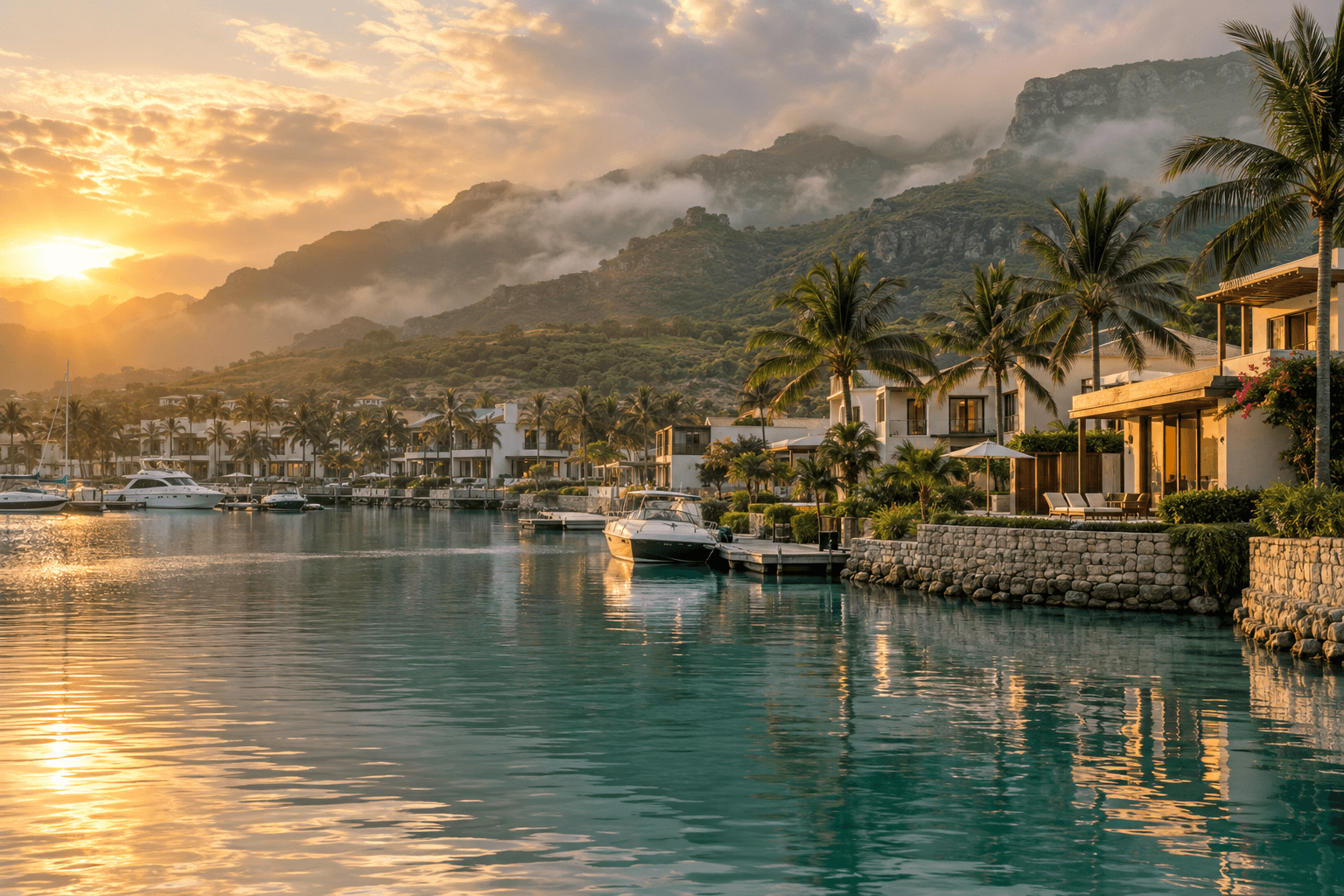
Hawana Salalah is the city's equivalent of Al Mouj in Muscat: a purpose-built, government-approved freehold destination built around a lagoon and marina, with hotels, restaurants, a golf course, and residential stock ranging from chalets to full villas. It's the address most international buyers encounter first when they start researching Salalah specifically, and for good reason — it's the most established, most amenity-complete freehold community south of Muscat.
Waterfront chalets and villas here carry a real premium over comparable stock elsewhere in the city, and that premium is earned mostly through khareef-season occupancy: owners who rent out short-term during July and August can generate a meaningful share of their annual income in that window alone. Outside the season, occupancy and rental demand drop noticeably, which is worth budgeting for honestly rather than extrapolating from a July snapshot. Hawana's marina and lagoon frontage also means unit-to-unit pricing varies a lot depending on the view and walk time to the water — treat "Hawana Salalah" as a price range, not a single number.
Buyer profiles here split fairly cleanly into three groups: GCC nationals buying a seasonal khareef retreat, international investors targeting short-let income, and a smaller number of owners who relocate to Salalah for part of the year and rent the unit out the rest of the time. Which group you fall into should shape which unit type and location within Hawana makes sense — a marina-facing chalet suits short-let income differently than a villa further from the water aimed more at personal use.
Al Saada and the City-Center Districts
Away from the resort feel of Hawana, Al Saada and the surrounding city-center neighborhoods are where a lot of Salalah's everyday residential activity happens — closer to schools, hospitals, government offices, and the city's retail core. This is less of a freehold-marketing story and more of a practical one: it suits buyers and tenants who actually live and work in Salalah year-round rather than visiting seasonally.
Ownership structures in these districts are less standardized than inside a purpose-built ITC — some stock is available to foreign buyers on a freehold or usufruct basis depending on the specific development, while much of the general residential market is oriented toward Omani nationals and long-term leasing rather than foreign freehold sale. If a listing in this part of the city is marketed to foreign buyers, confirm the exact ownership structure and zoning before assuming it works the same way a Hawana Salalah unit does — see our freehold vs usufruct guide for what the distinction actually means in practice.
The Coastal Road Toward Mughsail
West of the city, the coastal road toward Mughsail is scenic, sparsely developed, and increasingly on the radar of buyers thinking further ahead than the next five years. This stretch has fewer completed projects and less day-to-day infrastructure than Hawana or the city center, but it also has some of the most dramatic coastline in the country — dramatic enough that it's a genuine draw for Dhofar's own tourism ambitions beyond the khareef crowd.
Land plots and early-stage developments here are best understood as a longer-term, lower-liquidity play rather than a ready income property. Buyers considering this stretch should weigh it the same way they'd weigh any frontier location: real upside if regional tourism infrastructure keeps expanding south and west of the city, but a much thinner resale market today than anything inside an established ITC.
Getting To and Around Salalah
Salalah sits roughly 1,000km south of Muscat by road — a full day's drive, though most owners and visitors fly. Salalah International Airport runs regular domestic connections to Muscat (around 90 minutes in the air) plus a growing number of direct regional and seasonal international routes, particularly in the run-up to khareef. For an owner who won't be resident year-round, flight frequency and journey time from home matter as much as anything about the property itself — it's worth checking the current schedule rather than assuming Muscat-level connectivity.
Within the city, Hawana Salalah and the airport are both a short drive from the center, and the coastal road running west toward Mughsail and east toward the Yemeni border area is well paved and scenic for most of its length. A car is effectively essential — Salalah doesn't have Muscat's (still limited) taxi and ride-hailing density, so factor a rental or owned vehicle into any ownership plan.
Financing and Ownership Costs in Salalah
The costs of buying in Salalah follow the same national framework as Muscat — registration fees, agency fees, and the other line items covered in our true cost of buying guide apply here too, regardless of city. Mortgage financing for foreign buyers is also available on Salalah properties through the same lenders active in Muscat, though it's worth confirming with your bank that a specific Hawana Salalah unit or building is on their approved list before assuming financing will be straightforward — see our mortgage guide for what lenders typically look for.
One Salalah-specific budgeting point: if short-let income is part of the plan, factor in a local property manager or agency to handle guest turnover, cleaning, and khareef-season demand spikes, since remote self-management is far less practical here than for a long-term Muscat rental with a single tenant.
What to Weigh Before Buying in Salalah
Pulling the above together, a few points are worth keeping in view before committing to a specific unit:
- Rental income here is genuinely seasonal — model your return around realistic khareef-season occupancy, not a peak-month rate stretched across twelve months. Our rental yields guide covers how Salalah compares to Muscat on this specific point.
- Confirm freehold status building by building, not by neighborhood reputation — Hawana Salalah is unambiguous, but stock elsewhere in the city can vary considerably.
- Resale liquidity is thinner than Muscat's — expect to hold longer to find the right buyer if you need to exit, and price accordingly from the outset rather than assuming a quick sale.
- Weigh personal-use value alongside investment return — many Salalah buyers are drawn as much to having a khareef-season retreat as to the numbers on a spreadsheet, and that's a legitimate reason to buy even where the yield math is less favorable than Muscat.
Salalah rewards buyers who go in with realistic expectations about seasonality and liquidity rather than treating it as a smaller, cheaper version of Muscat — it's a genuinely different market with its own rhythm. This guide is general information based on publicly available details about the city and its freehold zones, not a substitute for touring specific units and confirming current pricing and availability. Browse current Salalah listings or get in touch to ask about the market there specifically.
More From the Blog

September 26, 2026
Jebel Sifah and Muscat Bay: Oman's Emerging Luxury Coastal Communities
Beyond Al Mouj and Muscat Hills, these two ITC-zoned marina communities south of the city are where a quieter, more resort-style buyer pool is looking.

September 26, 2026
Inheritance and Property Law in Oman for Foreign Owners
What happens to a freehold property in Oman if the owner passes away — and the estate planning steps that prevent it from becoming complicated for your family.

September 26, 2026
Short-Term Rental and Airbnb Regulations for Property Owners in Oman
Turning a freehold unit into a short-let earns strong khareef and tourism-season income — but only if it's licensed correctly. Here's the framework.