Living in Muscat as an Expat: Neighbourhoods, Costs and Lifestyle
September 4, 2026
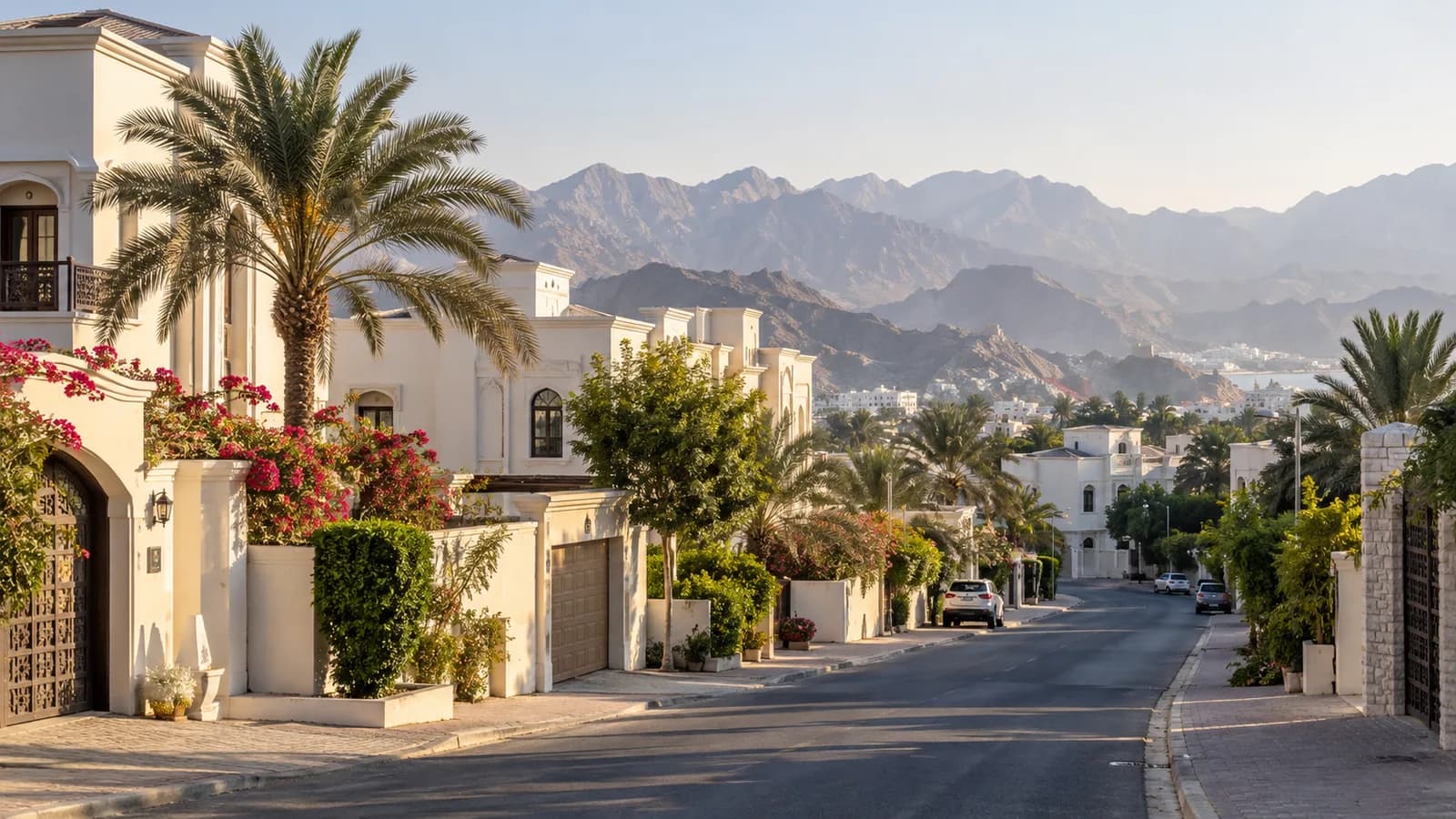
Muscat is one of the more understated capitals in the Gulf: low-rise, spread along the coast between the Hajar mountains and the Sea of Oman, calm in pace, and consistently ranked among the safest cities in the region. For expatriates it offers a comfortable, family-oriented life at a lower cost than Dubai or Doha, with the trade-off that it is quieter and more car-dependent.
This guide covers the practical side of living in Muscat — neighbourhoods, what it costs, schooling, healthcare, getting around and day-to-day life — with an eye on how those choices connect to renting or buying a home. It is general information; confirm current figures and rules before you rely on them.
Why expats choose Muscat
The draws are consistent across the people who move here: personal safety, a slower and less transactional atmosphere than neighbouring hubs, an outdoors that runs from coral reefs to 2,000-metre mountains within a couple of hours’ drive, and a local culture that is welcoming without being overwhelming. Oman is socially conservative but relaxed in practice for residents who are respectful of local norms.
The flip side: nightlife is limited, public transport is minimal, summer heat from June to September is severe, and career options are narrower than in the larger Gulf economies. Most expats who settle well in Muscat are those who value the lifestyle and the family environment over pace and scale.
Neighbourhoods
Al Mouj
The best-known master-planned community, built around a marina and golf course on the coast near the airport. Walkable by Muscat standards, with restaurants, a beach, supermarkets and a promenade. Popular with families and professionals who want amenities on the doorstep; it is also an Integrated Tourism Complex where foreigners can buy. See the Al Mouj area guide.
Muscat Hills
A gated golf community closer to the airport and city, quieter and more villa-heavy than Al Mouj, with a strong family following. Our Muscat Hills versus Al Mouj comparison weighs the two directly.
Qurum and Shatti Al Qurum
Central, established, and close to the beach, embassies, parks and the main shopping areas. A mix of apartments and older villas, with some of the city’s best-located rental stock. Convenient for people who want to be near the centre rather than in a compound.
Madinat Sultan Qaboos and Al Khuwair
Long-standing expat areas with international schools, clinics, supermarkets and restaurants. Practical and central, with a wide range of villa and apartment rentals.
Azaiba, Ghubrah and Bausher
Residential districts between the centre and the newer western suburbs. Generally better value on rent than Qurum or the branded communities, with easy highway access.
Al Seeb and Al Khoud
Further west toward the university and the newer growth areas. More affordable, more spread out, and a longer commute to the centre, but popular with families who want space.
Muscat Bay, Yiti and Aida
Coastal developments east and south of the centre, positioned as premium lifestyle communities. Newer, more resort-like, and further from schools and offices — better suited to buyers focused on the setting than to a short daily commute.
What it costs to live in Muscat
A single professional can live comfortably on roughly OMR 600–1,000 a month excluding rent; a family of four typically needs OMR 1,200–2,000 excluding rent and school fees, depending on lifestyle. The main line items:
- Rent — a one-bedroom apartment in a central area runs around OMR 350–600 a month; a two-bedroom in a sought-after community OMR 600–1,000; family villas in the branded communities considerably more.
- Utilities — electricity, water and internet come to about OMR 30–60 a month for an apartment, higher for a villa in summer when cooling costs peak.
- Groceries — comparable to or slightly below other Gulf cities; imported Western brands cost more, regional produce less.
- Dining — a meal at a mid-range restaurant is around OMR 6–10 per person; casual local food much less.
- Transport — a car is effectively essential. Fuel is cheap by global standards, and running costs are low.
If you are weighing whether to rent or buy at these price levels, our renting versus buying guide works through the maths.
The climate, month by month
Muscat’s year splits cleanly. From roughly October to April the weather is excellent — warm days in the mid-20s to low-30s Celsius, cool evenings, low humidity, and the season when outdoor life, camping and mountain trips happen. From May to September it is hot, with peak summer bringing daytime temperatures above 40 Celsius and, along the coast, high humidity that makes it feel worse. Air-conditioning runs constantly in those months and electricity bills roughly double.
This pattern shapes housing decisions. A villa with a large garden and a pool is wonderful for half the year and an expensive cooling and maintenance load for the other half. Apartments and townhouses in shaded, well-insulated buildings are more forgiving in summer. If you are viewing properties in the cool season, picture the same home in August before you commit.
Working in Muscat
Most expats arrive with a job already arranged, sponsored by an employer who handles the residency permit. The private-sector job market is smaller and more concentrated than in Dubai or Doha — oil and gas, financial services, construction, logistics, healthcare, education and tourism are the main employers of foreign professionals. Omanisation policy prioritises Omani nationals for many roles, which narrows the field further in some sectors.
Salaries are generally lower than in the UAE or Qatar for equivalent roles, but so is the cost of living, and there is no personal income tax. Business setup by foreigners is possible, and has become easier, but it is a bigger commitment than taking employment and is best approached with local advice.
Schooling
Muscat has a solid range of international schools following British, American, Indian and IB curricula, concentrated in the central and western districts. Annual fees vary widely: mid-tier international schools commonly run around OMR 1,800–4,500 a year, while the premium British and IB schools sit higher, roughly OMR 5,000–9,000 a year, before extras like registration, books, uniforms and transport.
Places at the most in-demand schools fill early, so if schooling drives your move, secure a place before you commit to a neighbourhood — then choose a home within a sensible drive of it. School run distances shape daily life in Muscat more than almost anything else.
Healthcare
Oman has good private hospitals and clinics, concentrated in Muscat. Employers are generally required to provide health insurance for their employees under the national health insurance scheme, and many expats add family cover privately. Budget in the region of OMR 40–100 a month for private cover for an individual, with family plans higher. Routine costs are moderate — a GP visit is roughly OMR 15–30, a specialist OMR 25–50 — but confirm what your policy covers before you need it, especially for maternity, dental and chronic conditions.
Getting around
Muscat has no metro and a limited public bus network, so nearly all residents drive. The city is strung out along the coast, which means distances are longer than the population suggests — a cross-town trip can take 30 to 45 minutes. Ride-hailing apps operate and taxis are available, but for a family the practical answer is one or two cars. An international licence is usually accepted initially, with conversion to an Omani licence once you have residency.
Daily life and culture
Weekends are Friday and Saturday. Oman is a Muslim country and Ramadan changes the rhythm of the day — shorter working hours, daytime eating in public restricted, quieter mornings and busy evenings. Dress is modest in public, more relaxed within compounds and private venues. Alcohol is available to non-Muslim residents through licensed hotels, restaurants and, with a permit, dedicated shops.
The compensations for the quiet are outdoors: diving and snorkelling off the coast, turtle beaches at Ras Al Jinz, wadis within an hour of the city, the Jebel Akhdar and Jebel Shams mountains for cooler-weather trips, and the desert further inland. Salalah in the south is a domestic-holiday destination in its own right during the khareef monsoon — our note on khareef and Salalah real estate explains why.
Residency and owning a home
Most expats live in Muscat on an employment-linked residency permit sponsored by their employer. Buying a property inside an Integrated Tourism Complex can, separately, make you and your family eligible to apply for a property-linked residency permit that is not tied to a job — useful if you want to stay in Oman independently of one employer. Our residency-through-property explainer covers how that route works and the value thresholds involved.
Moving your household, family and pets
Sea freight from Europe or Asia to Muscat typically takes several weeks; air freight is faster and much dearer. Furnished and semi-furnished rentals are common, so many people ship less than they expect to. Importing pets is possible with the right vaccination records and an import permit arranged in advance — start that process early, as it does not move quickly.
Spouses on a family-sponsored residency can generally live in Oman without restriction; the ability to work depends on securing a separate employment permit through an employer. Families should line up school places before arrival, since the better schools have waiting lists and a mid-year start is harder to arrange.
Community and settling in
Muscat’s expat community is smaller and less transient than Dubai’s, which cuts both ways: it can take a little longer to build a circle, but the friendships tend to be more stable because people stay longer. Sports clubs, dive centres, hiking groups, school parent networks and nationality associations are the usual routes in. The master-planned communities like Al Mouj have their own social life built around the marina, gym and cafes, which is part of why families with young children gravitate to them.
How Muscat compares on cost
For an equivalent lifestyle, Muscat generally runs cheaper than Dubai, Abu Dhabi and Doha — most visibly on rent in the prime communities and on schooling, and less so on imported groceries and dining out, which are broadly Gulf-standard. Fuel and utilities are inexpensive. The main offsets are lower typical salaries and fewer of the tax-free-bonus employment packages common in the UAE a decade ago. Net, many families find their disposable income goes further in Muscat, provided housing is chosen sensibly.
Practical setup checklist
- Banking — a local account is straightforward once you have a residency card; salary transfer is the norm.
- Connectivity — mobile and home internet are widely available; coverage is good across Muscat.
- Housing — leases are typically annual, often paid with post-dated cheques, with a refundable deposit; see the Renting Guide.
- Driving — sort a car early; it unlocks everything else.
- Schools — apply before choosing a neighbourhood.
Frequently asked questions
Is Muscat a good place to live for expats?
For families and people who value safety, calm and the outdoors, yes — it consistently ranks among the safest cities in the region and costs less than the larger Gulf hubs. It is a weaker fit for those wanting a fast-paced, walkable city with a big job market and nightlife.
How much does a family need to live in Muscat?
A rough guide is OMR 1,200–2,000 a month excluding rent and school fees for a family of four, with rent adding OMR 600 to well over OMR 1,600 depending on area and property type, and international school fees on top.
Which area of Muscat is best for families?
Al Mouj and Muscat Hills for amenities and community; Madinat Sultan Qaboos, Al Khuwair and Qurum for being central and close to schools; the western suburbs for more space at lower rent. Choose relative to your children’s school first.
Do I need a car in Muscat?
Effectively yes. There is no metro, buses are limited, and the city is spread along the coast. Most residents run one or two cars; fuel and running costs are low.
Can expats drink alcohol in Oman?
Non-Muslim residents can buy alcohol from licensed venues and, with a permit, from dedicated shops, and consume it privately or in licensed premises. Public drinking and drink-driving are treated seriously.
Should I rent or buy when I move to Muscat?
Most people rent for the first year to learn the city, then decide. Our renting versus buying guide works through when each makes sense.
Is Muscat right for you?
Muscat rewards people who want a safe, family-centred, outdoors-oriented life and are content with a slower pace and a smaller job market. It suits less well those who want a dense, walkable city with a big-city career market and nightlife. For many long-term residents, the calm is the point — and it is one of the reasons a growing number of expats choose to buy here rather than treat Oman as a short posting.
This article is general information, not legal, financial or relocation advice — costs, fees and rules change, so verify current details before you act. Browse property for sale in Muscat, read the freehold area guides, or get in touch with questions about a specific community.
More From the Blog

September 26, 2026
Jebel Sifah and Muscat Bay: Oman's Emerging Luxury Coastal Communities
Beyond Al Mouj and Muscat Hills, these two ITC-zoned marina communities south of the city are where a quieter, more resort-style buyer pool is looking.

September 26, 2026
Inheritance and Property Law in Oman for Foreign Owners
What happens to a freehold property in Oman if the owner passes away — and the estate planning steps that prevent it from becoming complicated for your family.

September 26, 2026
Short-Term Rental and Airbnb Regulations for Property Owners in Oman
Turning a freehold unit into a short-let earns strong khareef and tourism-season income — but only if it's licensed correctly. Here's the framework.