Can Foreigners Buy Property in Oman? A Complete 2026 Guide
September 4, 2026
Yes — foreigners can legally buy property in Oman, but only in specific places and under rules that are worth understanding before you start viewing listings. Ownership for non-Omanis is concentrated in government-approved Integrated Tourism Complexes (ITCs), where you can hold a home as freehold or on a long usufruct term, register it in your name, resell it, rent it out, and pass it on to your heirs. Outside those zones, the picture is much more restricted.
This guide explains who can buy, where, what you actually own, the nationality and building-level limits that sometimes apply, and the questions to settle before you sign anything. It is general information, not legal advice — confirm the specifics of any project with the developer and a licensed professional.
The short answer
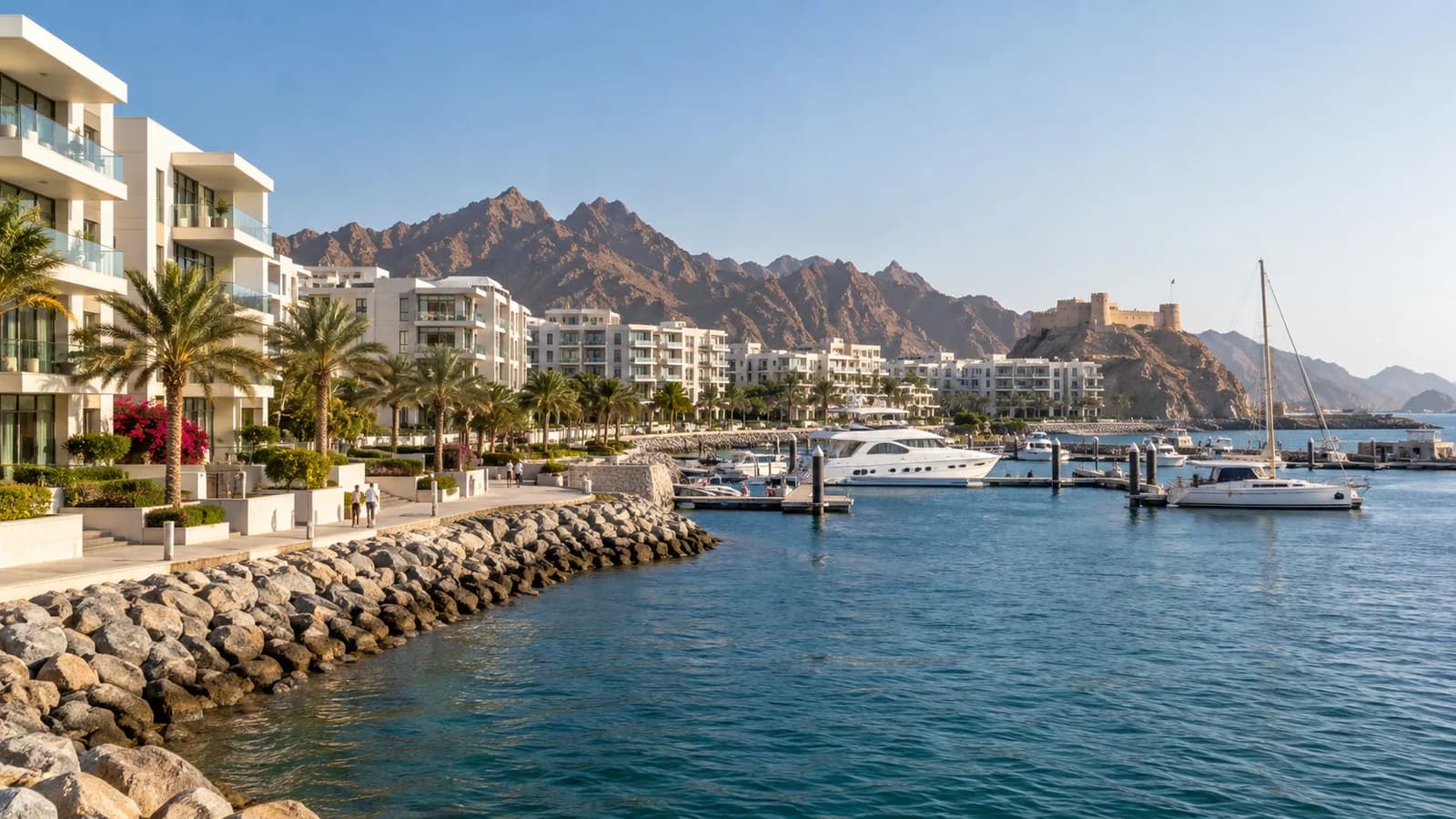
If you are a non-GCC foreign national, you can own residential property in Oman when the project sits inside a designated ITC. Developments such as Al Mouj Muscat, Muscat Hills, Muscat Bay, Jebel Sifah, Hawana Salalah, Aida in Yiti and several newer master-planned communities are structured this way. Inside these projects, apartments, townhouses and villas are sold to international buyers with title registered at the Ministry of Housing and Urban Planning.
What you generally cannot do as a foreigner is buy a house or a plot of land on the open market in a residential district that is not part of an ITC, buy agricultural land, or buy in areas near strategic or border locations. GCC citizens have wider rights than other nationalities and can own in a broader set of areas, subject to their own conditions.
What an Integrated Tourism Complex actually is
An ITC is a licensed, master-planned development that combines residential property with hospitality and leisure components — typically a hotel, a marina or golf course, retail, and public realm. The Omani government created the ITC framework specifically to allow foreign freehold ownership in a controlled way while channelling investment into tourism infrastructure.
Practically, this means three things for a buyer:
- Your ownership right is real and registered. You receive a title deed, not just a contract with a developer.
- The community is managed. ITCs run through an owners’ association funded by annual service charges, which cover security, landscaping, shared facilities and infrastructure upkeep. Budget for this as an ongoing cost.
- The location is fixed by licence. A project is either inside an approved ITC or it is not. A brochure calling a development “freehold” or “open to expats” is marketing language, not confirmation. Ask for the project’s ITC designation and verify it independently.
Freehold versus usufruct: what you are really buying
Inside an ITC you will encounter two ownership structures, and they are not interchangeable.
Freehold gives you outright ownership of the property for an unlimited term, the closest equivalent to how ownership works in most Western markets. Usufruct gives you the exclusive right to use, occupy, rent and sell the property for a long fixed term — commonly up to 99 years — after which the right expires or is renewed under the terms of the original grant.
Both are legitimate, both are registered, and both let you live in or let out the home. The differences matter most around resale value as a usufruct term shortens, and around how individual banks treat each structure for mortgage lending. Some projects inside an ITC offer only usufruct to non-GCC buyers even where freehold exists for others. Always get the specific structure for your unit confirmed in writing before you sign. Our guide to freehold versus usufruct covers the distinction in full.
Nationality rules and building-level limits
Some ITC projects apply caps on how much of a building can be owned by expatriates, and how much of that share can come from a single nationality. A common structure limits foreign ownership to a set percentage of units in a building, with a smaller sub-cap per nationality, so that no one national group dominates a development.
These limits are set at project level and are not uniform across Oman, so the only reliable answer for a specific building is the one the developer gives you. If you are buying in a development that is popular with your own nationality, ask early whether the relevant quota still has availability — it occasionally does not.
GCC nationals — citizens of Saudi Arabia, the UAE, Kuwait, Bahrain and Qatar — are treated more like Omani citizens for ownership purposes and are not subject to the same ITC-only restriction, though conditions still apply.
Do you need to live in Oman to buy?
No. You do not need to be a resident of Oman, and you do not need to already hold a job or visa there, to purchase in an ITC. Many buyers complete their purchase from abroad, appointing a lawyer locally under a power of attorney to handle signing and registration. You will need a valid passport, proof of funds, and to satisfy the developer’s and the bank’s standard anti-money-laundering checks.
Ownership can, separately, make you eligible to apply for a property-linked residency permit for you and your immediate family, tied to continued ownership of the home. The thresholds and permit lengths depend on the value of the property and current policy — our explainer on Oman’s residency through property investment walks through how that works.
Can buyers from specific countries purchase?
The ITC framework is nationality-blind in principle: it is open to non-GCC foreign nationals generally rather than to a fixed list of approved countries. In practice that means buyers from India, the United Kingdom, the United States, Pakistan, Egypt, the Philippines, South Africa, Jordan, Lebanon and across Europe and Asia all purchase in Omani ITCs.
The only nationality-specific mechanics you are likely to meet are the per-nationality building caps described above, and, in rare cases, a developer’s own compliance policy for buyers from sanctioned jurisdictions. If you are unsure how your nationality is treated in a particular project, ask the developer directly before paying a reservation fee.
What it costs a foreign buyer
The purchase price is only part of the outlay. As a foreign buyer you should plan for:
- Registration fee — a percentage of the purchase price payable to the Ministry of Housing and Urban Planning, charged at a higher rate for foreign buyers than for Omanis.
- Legal fees — typically one to two percent if you engage a lawyer for due diligence and conveyancing, which for a cross-border purchase is money well spent.
- Agency or brokerage fees where applicable, and smaller charges for certificates and translations.
- Ongoing service charges to the owners’ association, billed annually and set per square metre.
Added together, transaction costs commonly land around five to seven percent on top of the price. Our full breakdown of buying costs in Oman sets out the individual line items.
Can foreigners get a mortgage in Oman?
Yes, several Omani banks lend to non-residents and resident expatriates buying in ITCs, though terms are more conservative than for Omani nationals: larger down payments, shorter maximum terms, and stricter income verification. Off-plan purchases are often financed on a staged basis aligned to construction milestones. Our guide to mortgages for foreigners in Oman covers rates, deposits and the approval process in detail.
Buying off-plan as a foreigner
A large share of ITC stock is sold off-plan — reserved and paid for in instalments while the building is still under construction. For a foreign buyer this can be attractive: entry prices are usually lower than completed units, payment is spread over the build period, and you get first choice of layout and view. It also carries construction and delivery risk, which Omani regulation addresses through mandatory escrow.
Every licensed off-plan project must hold buyer payments in a dedicated escrow account at an approved bank. Money is released to the developer only as an independent inspector certifies that construction milestones have been reached, which protects buyers if a project stalls. Before you commit to an off-plan unit, ask which bank holds the escrow account, who signs off milestones, and what the contract says happens to your money if completion is delayed beyond a defined grace period. Our comparison of off-plan versus ready property goes through the trade-offs.
Can you buy through a company?
Some investors ask about buying in the name of a company rather than as an individual, usually for estate-planning or tax reasons in their home country. This is sometimes possible within an ITC, but it adds cost and complexity: the structure has to be acceptable to the developer, the registering authority and any lender, and it can affect eligibility for property-linked residency, which is designed around individual owners. If this matters to you, take advice in both Oman and your country of tax residence before you reserve anything.
The buying process in outline
- Confirm eligibility for the specific unit — ITC status, and whether your unit is freehold or usufruct.
- Reserve the property with a booking form and deposit, ideally refundable pending due diligence.
- Due diligence — verify the developer’s permits, the escrow arrangement for off-plan, service-charge history for resale, and read the Arabic contract, which is the version that carries legal weight.
- Sign the sale and purchase agreement and pay according to the agreed schedule.
- Register the title at the Ministry and pay the registration fee. Ownership is legally yours once registered, not before.
Our step-by-step registration guide and the main Buying Guide cover each stage in depth.
Common misconceptions
- “Freehold anywhere in Muscat.” No — foreign freehold is tied to ITCs, not to the city.
- “An ITC address guarantees freehold.” Not necessarily; some units in an ITC are sold as usufruct. Check your unit.
- “Buying gets me automatic citizenship.” It does not. Property ownership can support a residency application, which is different from nationality.
- “The English contract is what matters.” The Arabic text prevails in a dispute. Have it reviewed.
- “There are no ongoing costs.” Annual service charges apply in every ITC.
Where to look
If you are starting your search, browse current properties for sale across Oman, filter by Muscat or Salalah, or read the freehold area guides to understand which communities suit end-users and which suit investors. The Al Mouj area guide and our Muscat Hills versus Al Mouj comparison are good starting points for the two best-known communities.
Frequently asked questions
Can foreigners buy property in Muscat?
Yes, within Muscat’s Integrated Tourism Complexes — Al Mouj, Muscat Hills, Muscat Bay and others. Foreigners cannot buy a standalone house or land in an ordinary Muscat residential neighbourhood that is not part of an ITC.
Can foreigners buy land in Oman?
Generally no. Non-GCC foreign nationals cannot buy freehold land on the open market. What you can buy is a completed or off-plan home — apartment, townhouse or villa — inside an ITC, where the land sits under a managed community structure.
Is there a minimum property value for foreign buyers?
The ITC framework itself does not set a single national minimum purchase price, though individual projects have their own entry prices and the property-linked residency route has value thresholds. Check the current figures before assuming a purchase will qualify you for a particular permit.
Can a foreigner sell an Omani property to another foreigner?
Yes. Resale within an ITC is permitted, including to another foreign buyer, subject to the same nationality quotas that applied on the first sale. This is why the size of the resale buyer pool for a given community is worth thinking about before you buy.
Does buying property give me Omani residency automatically?
No. Ownership makes you eligible to apply for a property-linked residency permit; it is not granted automatically and it is not citizenship. See our residency-through-investment explainer.
How long does a purchase take?
A ready-property purchase can complete in a few weeks once due diligence is done and financing, if any, is approved. Off-plan runs on the construction timetable, with handover and final registration at completion, often two to three years out.
The bottom line
Foreigners can own property in Oman with genuine, registered, inheritable rights — provided the purchase is inside an approved ITC and you confirm whether your specific unit is freehold or usufruct. Settle the ITC status, the ownership structure, the nationality quota, the total cost and the escrow arrangement in writing before you pay anything beyond a refundable reservation.
This article is general information, not legal or financial advice — every transaction has its own specifics, so confirm details with us or a licensed professional before signing a contract. Read the full Buying Guide for the complete process, or get in touch with questions about a specific listing.
More From the Blog

September 26, 2026
Jebel Sifah and Muscat Bay: Oman's Emerging Luxury Coastal Communities
Beyond Al Mouj and Muscat Hills, these two ITC-zoned marina communities south of the city are where a quieter, more resort-style buyer pool is looking.

September 26, 2026
Inheritance and Property Law in Oman for Foreign Owners
What happens to a freehold property in Oman if the owner passes away — and the estate planning steps that prevent it from becoming complicated for your family.

September 26, 2026
Short-Term Rental and Airbnb Regulations for Property Owners in Oman
Turning a freehold unit into a short-let earns strong khareef and tourism-season income — but only if it's licensed correctly. Here's the framework.